Chapter One · From Verse 1
What would you be if your profession disappeared tomorrow?
A reflection on the difference between the grammar of a role and the judgment of the person beneath it.
The Verse
Bhaja Govindam, Bhaja Govindam,
Govindam Bhaja Moodhamate
Sampraapte Sannihite Kaale,
Na Hi Na Hi Rakshati Dukrinkarane
“Seek Govinda, seek Govinda, seek Govinda, O fool! When the appointed time — death — comes, grammar rules will not save you.”
The Teaching
Adi Shankaracharya composed this verse in a single breath of compassion. He saw an elderly Brahmin scholar — a man of obvious intelligence — spending his remaining days memorising the intricate rules of Sanskrit grammar. Every conjugation, every declension, every exception committed to memory with the dedication of a lifetime.
And Shankara was moved. Not because knowledge is wrong. Because the man had confused the map for the territory. He had mistaken the container for what it was meant to hold.
The word moodha — fool — is not contempt. It is tenderness. Shankara is addressing himself as much as the scholar. The fool is not unintelligent. He is someone who has organised his entire existence around the wrong thing, and done it so thoroughly that he has forgotten there was ever another option.
The grammar will not save you at the moment of death.
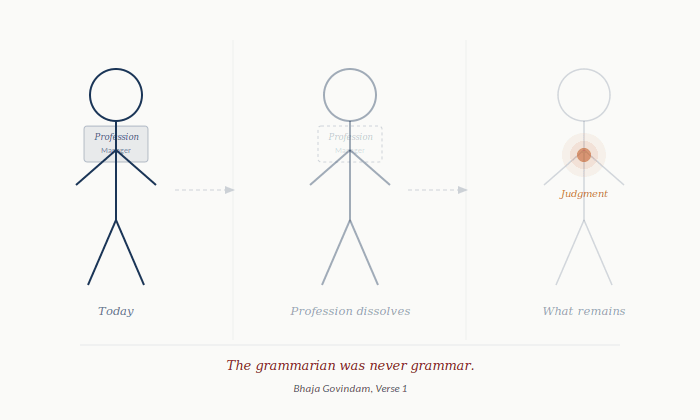
This is the first teaching. And it is not about death. It is about the impermanence of every role we build our identity around. The Sanskrit scholar’s grammar is the eighth-century equivalent of today’s job title, today’s credentials, today’s performance rating. The question Shankara presses upon us is not abstract. It is immediate and personal:
If the role disappeared tomorrow — what would remain?
The Career Lens
What would you be if all of that disappeared tomorrow?
This is not a hypothetical. Across every profession, the tools, structures, and systems around a role keep changing — reorganisations, mergers, new processes, shifting mandates — and each change quietly replaces the grammar people built their identity around.
The routine documentation. The scheduled reports. The coordination tasks that once justified the role. The outputs that were, until recently, proof of your contribution. Each of these keeps getting redefined, outsourced, or absorbed into someone else’s job description.
And most professionals do not notice until the question arrives in an unexpected form — a restructuring, a changed job description, a role that quietly narrows — and suddenly there is nothing obvious left to point to.
But here is what that moment of stripping away actually reveals: it was never the grammar that made you valuable.
It was the judgment underneath it. The ability to read a room and know what is actually being asked. The instinct to identify the real problem before anyone has named it. The capacity to make a decision when the data runs out and the situation still demands an answer.
That is not in the output.
That is not in the process.
That is the person underneath the role.
The market is beginning to understand this distinction. It is increasingly rewarding professionals who are known for their judgment. It is quietly capping those known only for their deliverables.
Shankara’s suggestion is not that you abandon your role. It is that you stop mistaking it for yourself. The grammar is a tool. The judgment is you. When the grammar is reorganised, outsourced, or handed to someone else, the judgment does not go with it. It stays. But only if you have been cultivating it — and only if you know it is there.
The Mirror
Sit quietly for five minutes. Then answer this honestly: if your job title were removed and replaced only with a description of the actual judgment you exercised over the last year — what would it say? What would people seek you out for, if the role no longer explained it?
The Move
This week, identify one decision you made that required genuine judgment — not process-following, not output-production, not coordination. Write it down in two sentences. That is the beginning of knowing what you actually bring. Add one entry every week.